How Long Should Curtains Be?
Curtains look right at one of three lengths: floating just above the floor, kissing it, or puddling onto it. The look you want sets the finished drop, and the finished drop is the number a fabric calculator needs. Float them half an inch above the floor, drop them to just kiss it, or let them puddle a couple of inches onto it. Each look has a clear allowance you add to the drop before you order.
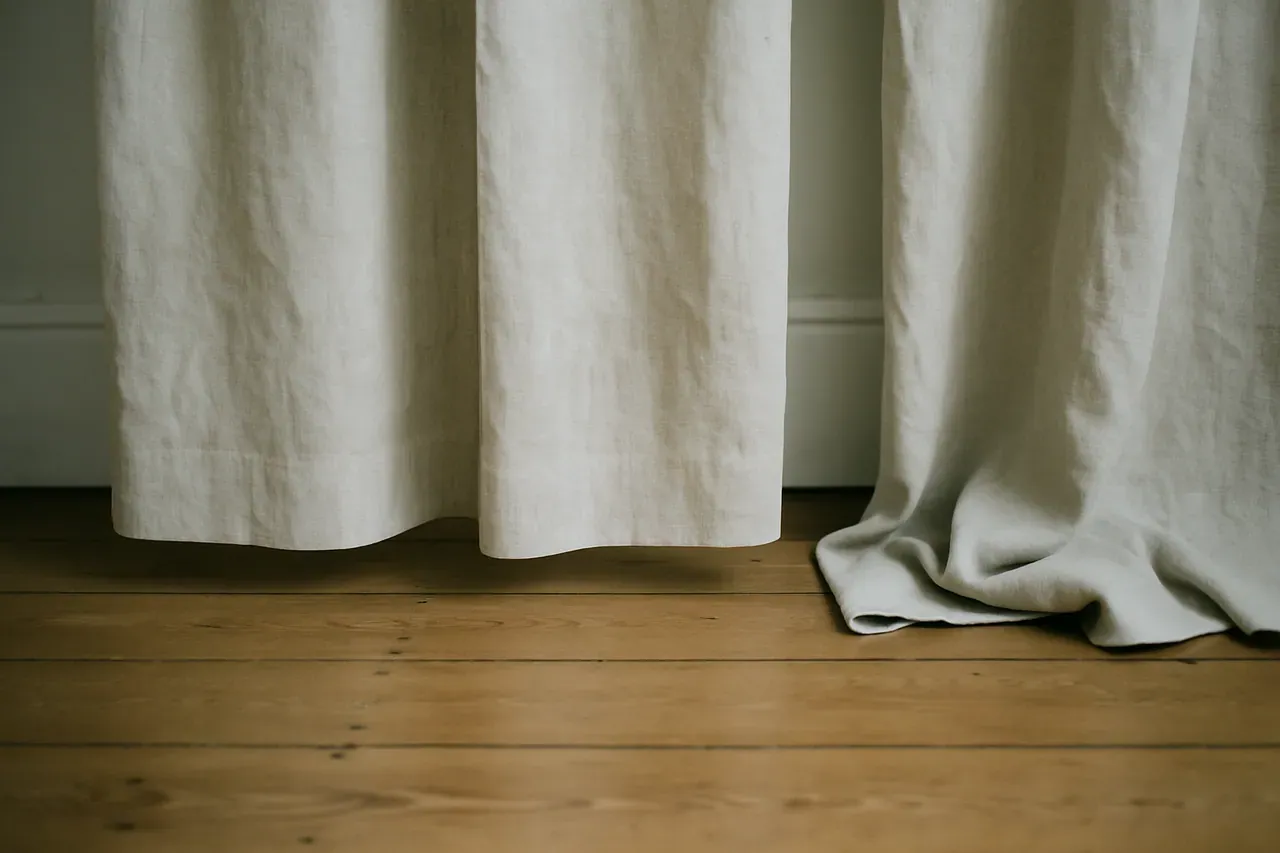
The three curtain lengths, and what they mean
Floor-length curtains look right at one of three finishes, and the difference between them is a couple of inches. Float, kiss, and puddle. Designers use all three, so the choice is about the room and how much upkeep you want, not about a single correct answer. The interior magazine Livingetc treats floor-length as the default for a flattering room, with the exact relationship to the floor left to taste.
- Float: the hem hangs about half an inch above the floor. Crisp, modern, easy to vacuum under, and the safest choice if your floor is uneven.
- Kiss: the hem just brushes the floor, with almost no gap. The classic tailored look. It needs an accurate drop, because a kiss that is too long becomes a slump.
- Puddle: the fabric breaks onto the floor by a couple of inches. Soft and dressy, good for formal rooms and bedrooms, more upkeep because it gathers dust.
How much should curtains puddle?
Add about two inches of extra length for a light puddle, and treat four inches as the most you want in a normal room. Under two inches and it looks like the curtain came up short by mistake. Over four and it turns into a pile of fabric that collects dust and reads as heavy rather than elegant. A two inch break is the sweet spot: enough to look intentional, little enough to still vacuum around.
The key is to build the puddle into the order. Add the two inches to your finished drop before you buy, so the fabric is there from the start. You cannot puddle a curtain that was cut to kiss the floor, but you can always hem a long one shorter, so when in doubt, order the longer length.
How far above the floor should curtains float?
About half an inch, roughly the thickness of a finger. That gap keeps the hem off the dust, lets the curtain swing freely when you draw it, and still looks full length rather than too short. Go much higher than an inch and the curtain starts to look like it shrank in the wash.
Floors are rarely level, especially in older homes. Measure the finished drop at several points across the width of the window and work to the shortest one, or the hem will float at one end and drag at the other. This is also why a kiss finish is the fussiest of the three: it leaves no margin for a sloping floor.
How length feeds the fabric calculation
Your chosen length is the finished drop, and the finished drop drives the whole fabric sum. Each width of fabric is cut to that drop plus the header and hem allowances, so a two inch puddle adds two inches to every width you buy, and a floating hem saves it. Over a tall pair that adds up. On a patterned fabric it matters more, because the cut length rounds up to a whole pattern repeat, and a small change in drop can push every width into one more repeat.
So decide float, kiss, or puddle before you order, then feed the finished drop into the curtain fabric calculator. It adds the header and hem, rounds to the repeat where needed, and prints the exact cut length per width. For the measuring itself, see how to measure for curtains, and if your fabric has a design, read pattern repeat explained so a longer drop does not quietly cost you a whole extra repeat.
Lock in your finished drop
Add your float or puddle allowance, then get the cut length per width.