Curtain Size Chart: What Size Do You Need?
Ready-made curtains come in a short list of standard sizes, not a size for every window. In the US that is a handful of lengths from 63 to 120 inches; in the UK and EU it is three or four drops sold as pairs. The trick is reading the chart, then adding fullness so the panels look right pulled shut. This guide sets the US and UK sizes side by side, in inches and centimeters, then shows how to read the chart and add the right fullness before you buy.
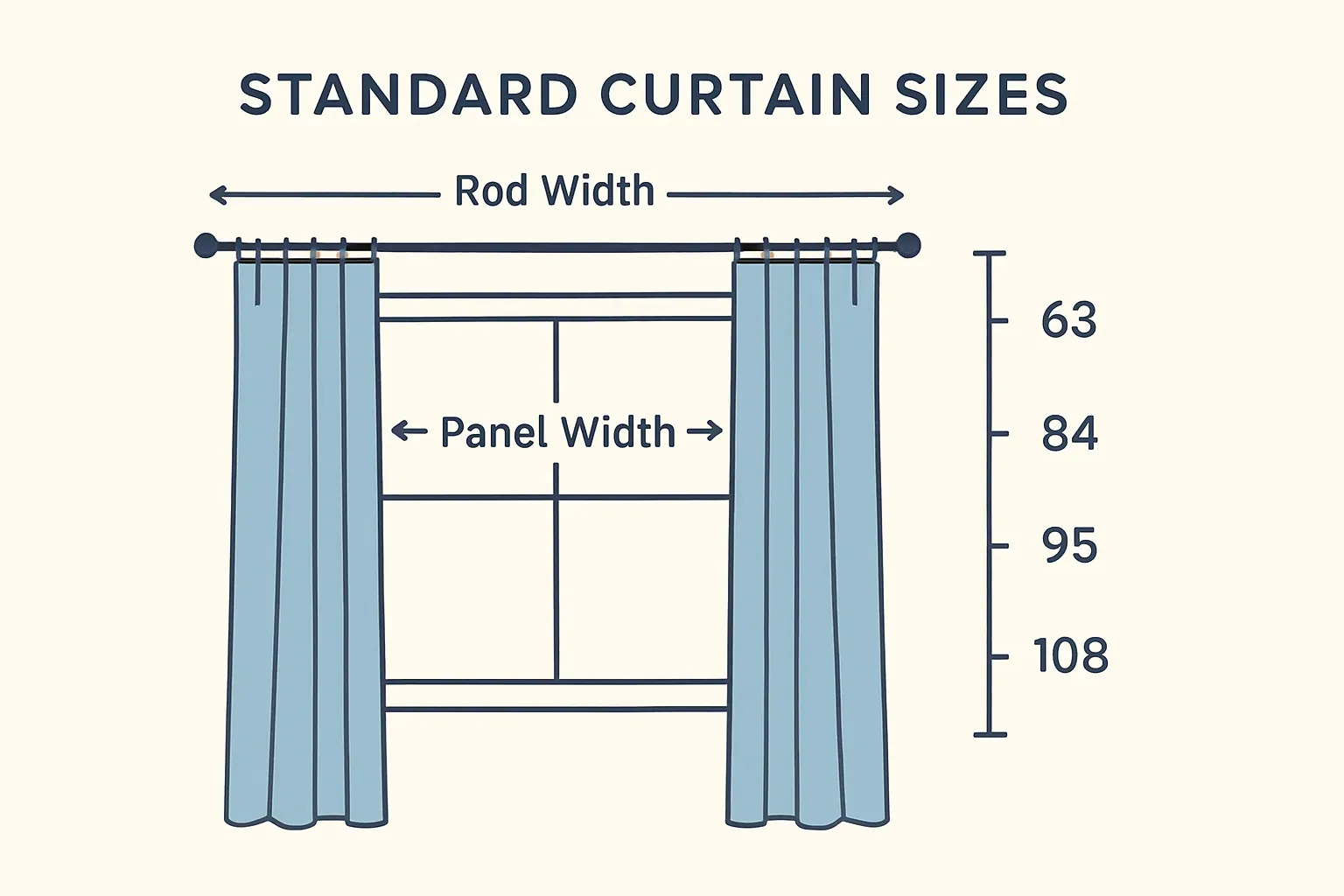
Standard curtain size chart (US, inches)
Ready-made curtains are sold in a small grid of standard sizes, so most of the job is matching your window to the nearest one and adding enough width. In the US, panels run 63, 84, 95 or 96, 108, and 120 inches long, in widths of about 50 inches each. The single most common length people buy is 84 inches, which suits a standard 8 foot ceiling. Mount the rod 4 to 6 inches above the window frame and most of these read as floor length.
| Length | Where it fits |
|---|---|
| 63 in | Short windows, above a radiator, or sill length on a taller window |
| 84 in | The most common size. Floor length on a standard 8 ft ceiling |
| 95 or 96 in | Taller windows, or a rod mounted well above the frame |
| 108 in | 9 ft ceilings, floor length |
| 120 in | 10 ft ceilings, or a high mount for a tall, dramatic look |
Panel widths are usually 42, 50, 52, or 54 inches each. American ready-made panels are sold one at a time, so two 50 inch panels give you 100 inches of fabric, which covers a rod up to about 50 inches wide at full two times fullness. Wider window, more panels.
Curtain sizes in the UK and EU (cm and inches)
UK and EU curtains are sold as a pair, and the width on the label is for both panels together, written as width then drop. A pair marked W66 x D72 is 66 inches wide across the pair and 72 inches long. The three main drops are 54, 72, and 90 inches, which is 137, 183, and 228 cm.
| UK size | Metric | Typical use |
|---|---|---|
| Drop 54 in | 137 cm | Sill or short windows |
| Drop 72 in | 183 cm | Below sill, most windows |
| Drop 90 in | 228 cm | Floor length on standard ceilings |
| Width 46 in (pair) | 116 cm | Narrow windows up to about a 40 in track |
| Width 66 in (pair) | 167 cm | The common width, tracks up to about 55 in |
| Width 90 in (pair) | 228 cm | Wider windows and patio doors |
Because the width is for the pair, a W66 pair splits into two 33 inch panels. Check your track width against that, not against the whole 66, or you can end up short on each side.
What size curtains do I need?
Start with two numbers: your rod or track width, and the drop from the top of the rod to where you want the hem. For width, multiply the rod width by 2 to 2.5 and pick the panel count that gets you there. The Window Coverings Association of America treats two times the rod width as the standard fullness for most headings. For length, add the rod height above the frame, then decide if the hem floats, kisses, or puddles.
Say your rod is 48 inches wide and sits 5 inches above an 80 inch window opening. You want about 96 to 120 inches of curtain across it, so two 50 inch panels work. The drop from rod to floor might be 92 inches, so 95 inch panels floating just above the floor are the safe pick. When your window sits between two chart sizes on width, round up and let the extra become fuller folds.
Why don't the standard sizes fit my window?
Because ready-made is a grid of maybe five lengths and three widths, and real windows are not. If your rod lands between sizes, or you want a heading like a triple pinch pleat that eats more fabric, the chart runs out and you are into made-to-measure. That is where the numbers stop being a lookup and start being a calculation.
At that point, feed your real width, drop, heading, and any pattern repeat into the curtain fabric calculator and it works out the widths, the cut length, and the total yardage for you. For taking the measurements cleanly, read how to measure for curtains. To set the finished length before you order, see the curtain length guide, and to choose how much fullness your heading needs, check the fullness and pleat guide.
Between two sizes? Get the exact figure
Enter your real width, drop, and heading and get the widths to cut and the total fabric, in inches or metric.