How Wide Should Curtains Be?
Curtains have to hang in folds when they are shut, so the flat width of all the fabric has to beat the rod by a wide margin. Two times the rod width is the working floor, and the width you multiply includes the returns at each end and the overlap in the middle. A 60 inch rod wants around 120 inches of curtain across it, split into two panels of roughly 60 inches each. Go under 1.5x and the pair reads as a flat sheet on a pole.
How do you calculate curtain width?
Measure the rod end to end. Add 3.5 inches for each return and 2 inches for each overlap. Multiply that total by the fullness your heading needs, usually 2. Divide the answer by the width of one panel and round up. That number is how many panels or fabric widths you buy.
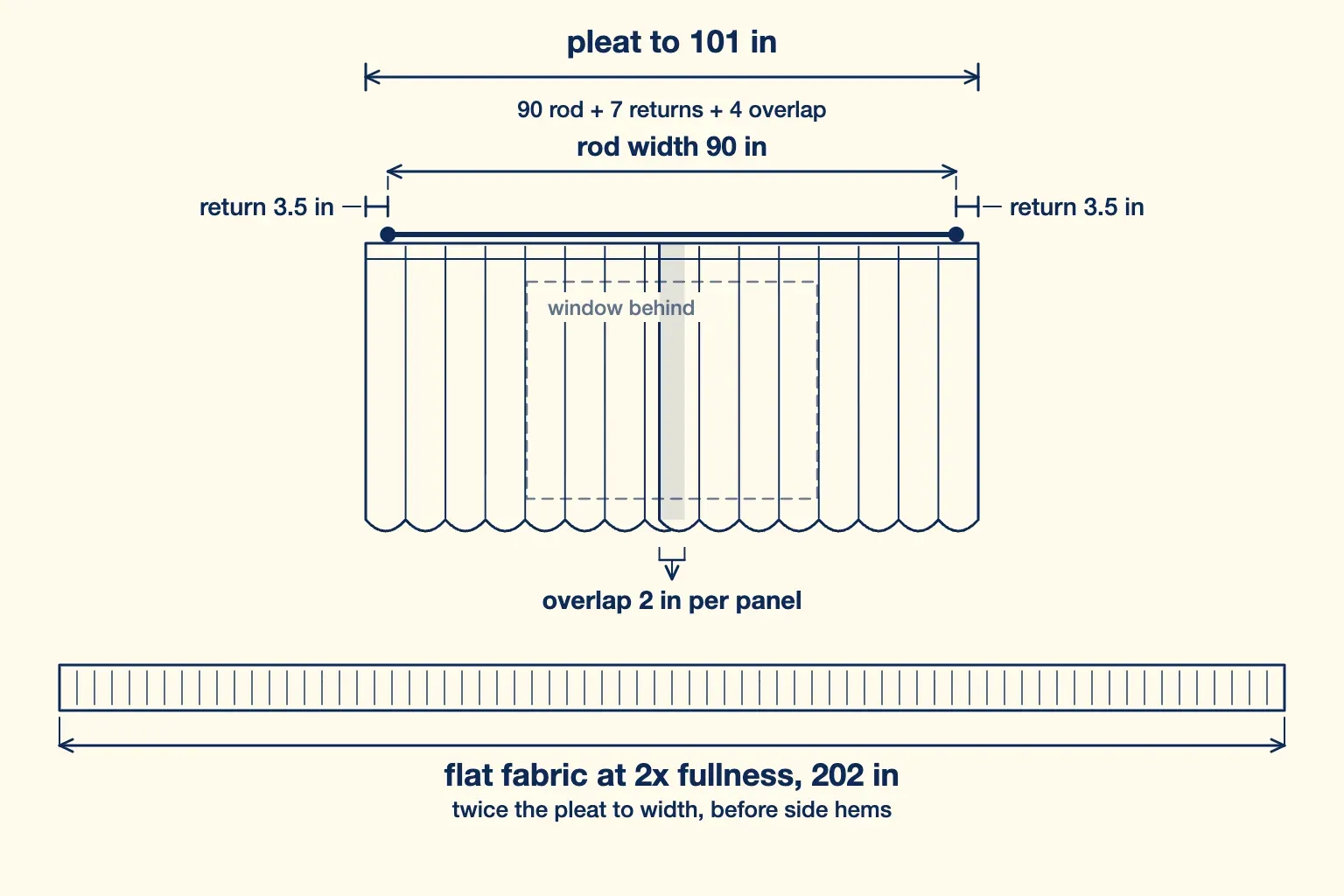
The rod width you multiply is not the bare rod, though. Fabritec Designs' drapery measuring sheet adds the returns and the overlap first: a 90 inch rod, plus a 3.5 inch return at each end, plus a 2 inch overlap per panel, comes to 101 inches. That 101 is the number a workroom pleats to. Leave those 11 inches out and the finished pair falls short at both walls and in the middle.
Returns are the bit of curtain that wraps back to the wall at each end. They exist because the brackets hold the rod 3 to 4 inches off the plaster, and without a return you get a lit gap running down the side of the panel. Overlap is where the two curtains cross in the middle on a traverse rod. Two inches per panel is the standard, and it is the difference between a dark bedroom and a stripe of streetlight across the ceiling.
A one-way panel is simpler. One return, no overlap: rod width plus 3.5 inches, then multiply.
Fullness is the multiplier that sets the width
Fullness is the ratio between flat fabric and covered rod, and your heading picks it for you. Threadwell, the workroom supplier formerly trading as Quiltcraft, puts 180% at the bottom of the range for anything you would call a true pinch pleat. Below that the folds flatten out.
Here is what each heading does to the same 101 inch pleat-to width.
| Heading | Fullness | Flat fabric needed (rounded) |
|---|---|---|
| Tab top | 1.5x | 152 in |
| Eyelet or grommet | 1.6x | 162 in |
| Gathered or rod pocket | 1.75x | 177 in |
| Pencil pleat | 2x | 202 in |
| Wave or ripplefold | 2x | 202 in |
| Pinch or triple pleat | 2.5x | 253 in |
Sheers run the other way. They are thin enough to look sparse at 2x, so most workrooms take them to 2.5x or 3x. The fullness and pleat guide works through why each heading lands where it does.
How many curtain panels do I need?
Divide the total curtain width by the width of one panel and round up, then round again to an even number if you are hanging a pair. Ready-made panels in the US are usually 50 inches wide, so a 90 inch rod at 2x fullness needs 180 inches, which is 3.6 panels, so four.
Ready-mades never get pleated to a spec, so for these you can work straight off the rod width and leave the returns and overlap out of it.
| Rod width | Curtain width at 2x | 50 in panels |
|---|---|---|
| 36 in | 72 in | 2 |
| 48 in | 96 in | 2 |
| 60 in | 120 in | 4 |
| 72 in | 144 in | 4 |
| 90 in | 180 in | 4 |
| 108 in | 216 in | 6 |
| 144 in | 288 in | 6 |
NICETOWN's panel guide arrives at the same place from the other direction: two panels for a 24 to 36 inch rod, four for a standard 60 to 72 inch bedroom or living room window, four to six once you are past 100 inches at a patio slider.
Sewing your own? Fabric width decides it
Decorator fabric comes off the bolt at 54 inches. Turn a 2 inch side hem on each edge and you have about 50 inches of usable width per drop. A deeper 1.5 inch double hem takes it nearer 48. Designer Linda Merrill puts a finished single-width panel at 48 inches, and warns off the 30 inch ready-mades some shops still sell, because there is not enough fabric in one to fold properly.
So the count is the pleat-to width times the fullness, divided by the usable width, rounded up, then split evenly between the two curtains. Widths come in whole numbers. You cannot buy 5.05 of them, and the leftover is why fabric width and railroading is worth reading before you order a wide window.
Why the width on the label is one curtain, not the pair
UK and EU ready-mades are sold as pairs, but the width printed on the packet is a single curtain. Terrys Fabrics states it plainly: a 66 x 90 pair is two curtains of 66 inches each. Buy the pair whose stated width matches or beats your track and the two together land near 2x.
| Track width | Order each curtain at |
|---|---|
| Up to 46 in (117 cm) | 46 in (117 cm) |
| 46 to 66 in (117 to 168 cm) | 66 in (168 cm) |
| 66 to 90 in (168 to 228 cm) | 90 in (228 cm) |
| 90 to 132 in (228 to 335 cm) | 132 in (335 cm) |
US listings are less consistent. Some sell one 50 inch panel, some sell a two-pack off the same photo. Check the quantity before you check the price. The curtain size chart has the full standard sizes for both sides of the Atlantic.
Can curtains be too wide?
Yes, in two ways. Too much fabric on a light rod bows it, and a pair of blackout-lined panels can pass 20 pounds once it is made up. The other cost is stack-back: pleated drapery bunches to roughly a third of its own flat width at each end, so every bit of extra fullness covers more glass when the curtains are open.
That is the trade. More fullness looks better shut and eats more window open. If your rod already runs 8 to 12 inches past the frame on each side, 2x is where most rooms land. How to measure curtain rods covers the stack allowance and where the brackets go.
A worked example
Say the rod runs 90 inches, the brackets hold it 3.5 inches off the wall, and you want a triple pinch pleat made up.
Pleat-to is 90, plus 7 for the two returns, plus 4 for the two overlaps: 101 inches. At 2.5x fullness that is 252.5 inches of flat fabric. On 54 inch goods with a 2 inch side hem you get 50 inches per drop, so 252.5 divided by 50 is 5.05 widths.
Round up to six, three per curtain, and each finished curtain pleats to about 50.5 inches. Look at how close 5.05 sits to 5. A pair needs an even number of widths anyway, so six is the answer either way here, but on a single one-way panel that 0.05 of a width would cost you a whole extra drop. Shaving the fullness to 2.4x, or losing an inch off the rod, is sometimes the cheaper call.
Put the rod width, your drop, the heading, and the fabric width into the curtain fabric calculator and it returns the widths to cut, the cut length, and the total yardage, in inches or metric, with a printable cut list. It also flags the case above, where you land just over a whole width. To take the rod and drop measurements cleanly first, read how to measure for curtains.
Turn your rod width into fabric
Enter the rod width, your drop, and your heading, and get the widths to cut and the total yardage.