How to Measure Curtain Rods for Your Window
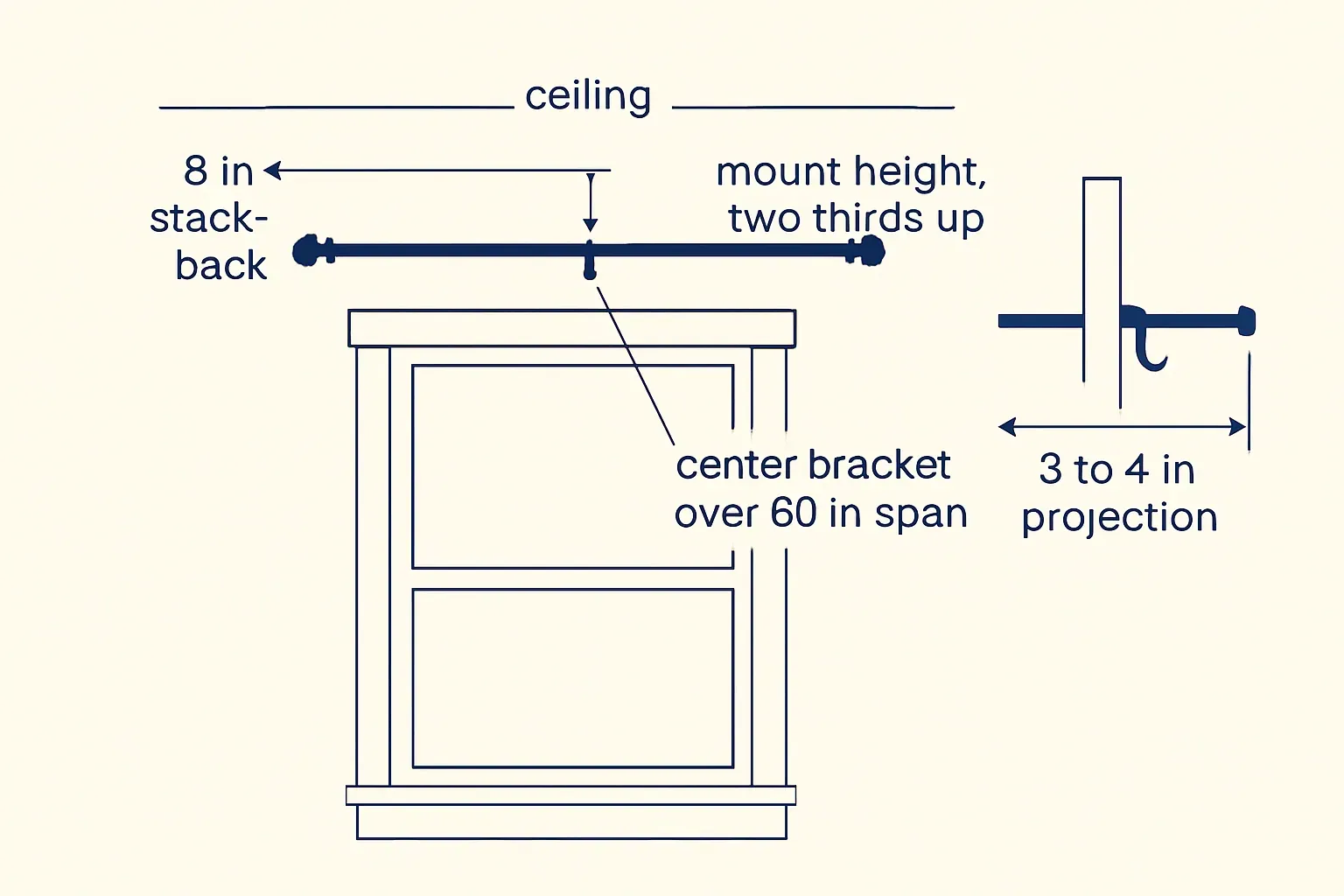
A curtain rod is three measurements, not one: how long the rod runs, how high above the frame it mounts, and how far it stands off the wall. The rod width you land on is also the number every fabric calculation starts from, so it pays to get it right before you drill. Length is the one people get wrong. The Shade Store puts a standard outside-mount rod at 6 to 12 inches wider than the window frame on each side, so a 36 inch window wants a rod between 48 and 60 inches.
How do you measure for a curtain rod?
Measure the outside of the window casing, edge to edge, with a metal tape. Add 6 to 12 inches per side for stack-back. That total is your rod length. Then measure from the top of the casing to the ceiling for mounting height, and check how far anything already on the window sticks out.
That extra width is not decoration. It is where the curtains sit when they are open, which drapery workrooms call stack-back. Continental Window Fashions allows about one third of the window width for it. Skip the allowance and your open curtains cover the glass, which is the thing you were trying to avoid.
Three practical notes before you buy. Measure the wall you actually have, not the window in isolation, because a rod that runs into a corner, a light switch, or the next window casing is no good. Round to the nearest 1/8 inch. And remember the finials sit outside the last bracket: they run anywhere from about 1.5 to 9 inches each, so a 76 inch rod with 4 inch finials needs 84 inches of clear wall.
Standard curtain rod lengths (size chart)
Telescoping rods are sold in a handful of adjustable ranges. The window widths below come from the rod range minus 12 inches, which is 6 inches of stack-back per side at the low end.
| Adjustable range | Window widths it covers | Where you see it |
|---|---|---|
| 28 to 48 in | Up to about 36 in | Bathroom, kitchen, small bedroom windows |
| 48 to 84 in | About 36 to 72 in | Standard single and double windows |
| 66 to 120 in | About 54 to 108 in | Wide living room windows and sliders |
| 120 to 170 in | About 108 to 158 in | Patio doors, tall picture windows |
| 170 to 240 in | Over 158 in | Bay runs and oversized openings |
Pick the range that puts your number near the middle, not at the last inch. A telescoping rod extended to its limit has almost no overlap between the inner and outer tube, and that is where it bows once a lined panel is hanging on it.
How high above the window should a curtain rod go?
The Shade Store's rule is to mount about two thirds of the way up the wall between the top of the window and the ceiling. Continental Window Fashions puts the floor at 4 inches above the casing, minimum. For the tall look, go higher: 2 to 3 inches below the ceiling line, or just under the crown molding.
Cathedral and vaulted ceilings break the two thirds rule, since two thirds of nine feet of blank wall puts the rod nowhere near the window. There, mount 8 to 10 inches above the frame and stop. And whatever height you choose, mark it and measure your drop from the top of the rod, because that height is now part of your finished curtain length.
Projection: how far the rod stands off the wall
Projection is the full depth of the bracket, measured from the wall plate to the outer end. Standard telescoping and traversing rods use adjustable brackets with a 3 1/2 to 4 1/2 inch return, and most decorative brackets project 3 or 4 inches. That is enough to clear a window sill and let the fabric hang straight.
Layering changes the number. If you are hanging drapery over wood blinds, a shade, or a sheer on a second rod, measure how far that inner treatment sticks out from the wall and add 2 inches. Then buy an extended projection bracket that reaches it. Two inches of clearance is what keeps the face fabric from resting on the blind and creasing along every slat.
When do you need a center support bracket?
Once the span passes about 60 inches. Continental Window Fashions puts two end brackets as the limit for metal rods of 1 to 1.5 inches and for 1 3/8 inch wood poles at 60 inches, with a third bracket in the middle above that. Chunky 2 and 3 inch wood poles hold to 96 inches. Wrought iron can run 8 feet on two brackets.
Weight decides the rest, and weight is set by rod diameter. TheSize.net lists rod capacity this way:
| Rod diameter | Holds about | Suits |
|---|---|---|
| 5/8 in | Up to 10 lb | Sheers and cafe curtains |
| 3/4 in | 10 to 15 lb | Unlined cotton and poly panels |
| 1 in | 15 to 25 lb | Lined panels |
| 1 3/8 in | 25 to 35 lb | Heavy lined or interlined drapery |
| 2 in | 35 to 50 lb | Extra heavy drapery and long spans |
A pair of blackout-lined panels for a wide window can run past 20 pounds once it is made up, so a 5/8 inch tension rod is the wrong tool even if the length fits.
A worked example
Say the window casing measures 60 inches across, with 14 inches of wall between the top of the casing and the ceiling. Add 8 inches of stack-back per side and the rod is 76 inches, which sits comfortably mid-range on a 48 to 84 inch rod. Two thirds of 14 is a little over 9, so the brackets go 9 inches above the casing. At 76 inches the span is over 60, so you are buying a third bracket for the center.
Now the fabric. That 76 inch rod is the width your curtains have to cover, and at two times fullness you need about 152 inches of finished curtain across it, before returns and overlap. That is the number that decides how many fabric widths you cut.
Feed the rod width, your drop, and your heading into the curtain fabric calculator and it returns the widths to cut, the cut length, and the total yardage. For taking the drop and width measurements cleanly, read how to measure for curtains. To match a rod to ready-made panels instead, check the curtain size chart, and to work out how much fullness your heading needs, see the fullness and pleat guide.
Turn your rod width into fabric
Enter the rod width, your drop, and your heading, and get the widths to cut and the total yardage.