Pinch Pleat vs Ripplefold
Pinch pleat is the tailored, traditional heading: stiffened pleats at about 2.5x fullness, hung on rings or a traverse rod. Ripplefold is a soft, even S-wave on snap tape at about 2x, and it only works on a matching track. That's the whole choice in two lines. The rest is fabric, stack, and hardware.
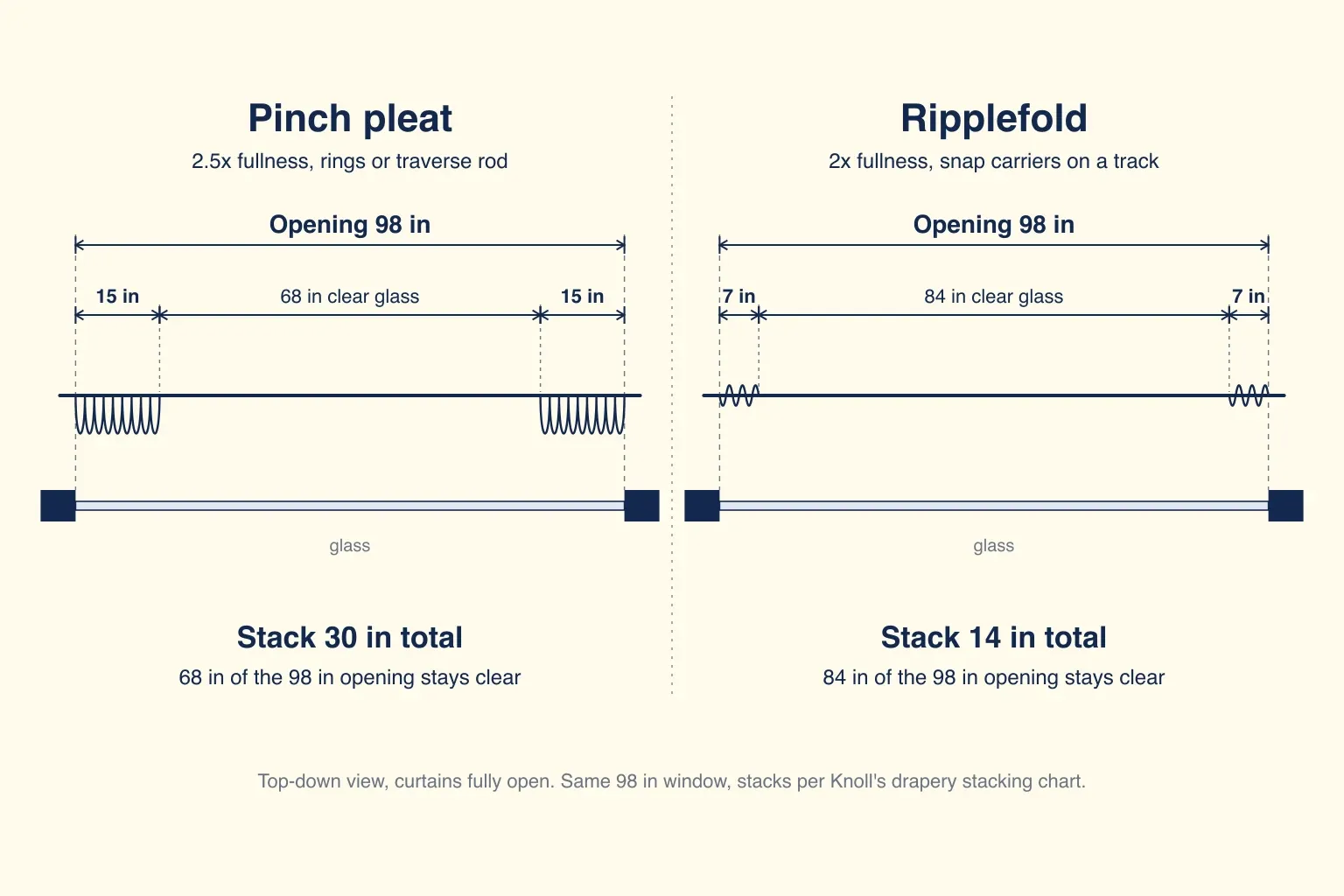
The stack is where they differ most. Knoll's drapery specification guide puts the open stack for a 98 inch opening at 30 inches for pinch pleat and 14 inches for ripplefold. On that window, ripplefold leaves 16 more inches of glass clear when the curtains are open.
What is the difference between pinch pleat and ripplefold?
A pinch pleat gathers the fabric into groups of folds (two or three) stitched at the top over a stiff buckram band, with flat spaces between them. Ripplefold has no pleats at all. Snap tape sewn across the top clips onto carriers in a track, and the fabric falls into one continuous, evenly spaced wave from end to end.
The look follows from that. Pinch pleat reads formal and structured, with crisp columns of fabric under each pleat. Ripplefold looks the same from the front and the back, and it's the heading you see in hotels, offices, and modern living rooms with floor-to-ceiling glass.
Side by side
| Feature | Pinch pleat (triple) | Ripplefold |
|---|---|---|
| Standard fullness | 2.5x | 2x (sold as "100%") |
| Other fullness options | 2x for a double pleat | 1.6x, 1.8x, 2.2x |
| Heading | Buckram stiffener, about 4 in | Snap tape, no buckram |
| Hangs on | Rings on a pole, or hooks on a traverse rod | A ripplefold track with snap carriers only |
| Stack when open (98 in opening) | About 30 in | About 14 in |
| Look | Tailored columns, traditional | Even waves, modern |
| Sewing at home | Pleat math and hand tacking | Straight seams, then sew on the tape |
The fullness numbers are the ones built into the curtain fabric calculator (triple pinch 2.5, wave or ripplefold 2.0), so the table and the tool agree.
The 4 inch buckram comes from Knoll's pinch pleat spec, which double folds it into the heading and bar tacks each pleat 1 inch above the bottom of the band.
How much fabric does each one use?
Ripplefold uses about 20% less flat width than a triple pinch pleat, because 2x is 20% less than 2.5x. You'll see sellers claim ripplefold uses half the fabric. It doesn't. And the real gap on your order depends on how the widths round, which can make the saving anywhere from a few inches to several yards.
Here's the same window run both ways through the calculator. The fabric is 54 inch decorator goods with a 2 inch side hem on each edge, so each width gives 50 usable inches. Finished drop is 84 inches with a 4 inch double hem.
On a 96 inch rod:
- Pinch pleat: 96 x 2.5 = 240 inches flat. 240 / 50 = 4.8, so 5 widths, and a pair rounds that to 6 (3 per curtain). Each cut is 100 inches (84 drop, 8 for the heading, 8 for the hem). Total 600 inches, 16.67 yards.
- Ripplefold: 96 x 2 = 192 inches flat. 192 / 50 = 3.84, so 4 widths (2 per curtain). Each cut is 96 inches, since the tape heading needs only 4. Total 384 inches, 10.67 yards.
That's 6 yards apart. At $30 a yard it's $180 of fabric before you've paid for any hardware.
Now shrink the rod to 72 inches. Pinch pleat needs 180 inches flat (3.6 widths) and ripplefold needs 144 (2.88 widths). Both round up to 4 widths for a pair. The only difference left is the shorter heading allowance, 16 inches across the whole order. Run your own rod width before you let the heading decide your budget.
Why does ripplefold stack so much tighter?
Ripplefold stacks tighter because its folds are uniform and soft, so they nest into each other when the curtain is pushed open. A pinch pleat has a stiff buckram top and extra fabric at every pleat, which holds the folds apart. The stack is the width of wall or glass the open curtain covers, and it decides how much window you get back.
Knoll's stacking chart gives these totals for each heading:
| Window opening | Ripplefold | Pinch pleat | Pencil pleat |
|---|---|---|---|
| 54 in | 7 in | 20 in | 18 in |
| 76 in | 8 in | 25 in | 23 in |
| 98 in | 14 in | 30 in | 27 in |
| 120 in | 17 in | 36 in | 32 in |
| 142 in | 21 in | 41 in | 37 in |
Not every source is that generous to ripplefold. Drapery Rods Direct, working from Kirsch's stack guides, adds 26 inches of stack for a 100% ripplefold on an 84 inch window and 30 inches (15 per side) for a 2.5x pinch pleat. Heavy fabric, lining, and interlining all make a stack fatter. If your drapes are lined, plan for the bigger number.
Either way, the stack goes on the rod beyond the window if you want the glass fully clear. How to measure curtain rods covers how far past the frame to run the rod.
What hardware does each heading need?
Pinch pleat hangs on almost anything. Pin a drapery hook into the back of each pleat, then hook it onto a ring on a decorative pole or onto the slides of a traverse rod. If you already own a pole and rings, a pinch pleat drape will hang from it.
Ripplefold won't. It needs a ripplefold track whose carriers are spaced for one fullness, and the drapery has to be made at that same fullness. Drapery Rods Direct, a Kirsch dealer, is blunt about it: the rod's ripplefold fullness must match the panel's. The tape itself is standard, 1 inch wide with snaps every 4.25 inches according to SK Theatrical Draperies, and the carrier spacing on the track does the rest.
That makes ripplefold a two-part purchase. Order the track and the drapes together, or at least decide the fullness before you buy either one.
What does "100% fullness" mean for ripplefold?
Ripplefold fullness is quoted as the extra fabric over the track width, not the total. So 100% fullness is 2x the track, 60% is 1.6x, 80% is 1.8x, and 120% is 2.2x. Knoll's guide uses the same convention: 0% covers the opening flat, 100% is double.
This trips people up when they move between a ripplefold vendor and a pattern or a calculator that uses multipliers. If the track is sold as 100%, enter 2.0. More fullness means more, smaller ripples and a slightly wider stack. Less fullness gives fewer, broader waves and a flatter look.
Can you sew ripplefold at home?
Yes, and it's the easier of the two to sew. Ripplefold panels are flat: side hems, a bottom hem, and the snap tape stitched across the top. There's no buckram and no pleat spacing to work out. Knoll's spec says it outright: no buckram is needed for ripplefold.
Pinch pleat takes more planning. You have to divide the flat width into pleats and spaces so the pleats land evenly and the seams hide behind them, then stitch and tack every pleat by hand or machine. It's not hard, but a mistake in the pleat math shows across the whole window.
The catch with ripplefold is hardware, not sewing. The track costs more than a pole and has to be bought to match.
Where does pencil pleat fit?
Pencil pleat is the budget middle ground. It's a gathered tape heading at about 2x fullness, so it uses the same fabric as ripplefold, and it hangs on a pole or a track. But it stacks almost as wide as pinch pleat: 27 inches against 30 for a 98 inch opening in Knoll's chart. It's the everyday heading in the UK and a fair pick when you want soft gathers without new hardware.
The curtain fullness and pleat guide lists the fullness for every heading, including eyelet, tab top, and rod pocket.
Which should you choose?
Pick pinch pleat if:
- You're keeping an existing pole or traverse rod.
- The room is traditional or formal and you want structure at the top.
- The window is small enough that a 20 to 30 inch stack doesn't matter.
Pick ripplefold if:
- It's a wide window or a slider and you want the glass clear when the drapes are open.
- You're installing new hardware anyway, ideally a ceiling-mounted track.
- You want the drapes to look the same from inside and from the street.
Once you've picked, work out the width with how wide should curtains be, then put the rod width, the drop, and the heading into the calculator. Choose "Pinch / triple pleat" or "Wave / ripplefold" and it gives you the widths to cut and the yards to buy.
Run both headings on your window
Enter the rod width, drop, and fabric width, then switch between pinch pleat and ripplefold to see the widths and yards for each.