How to Measure Fabric by the Yard
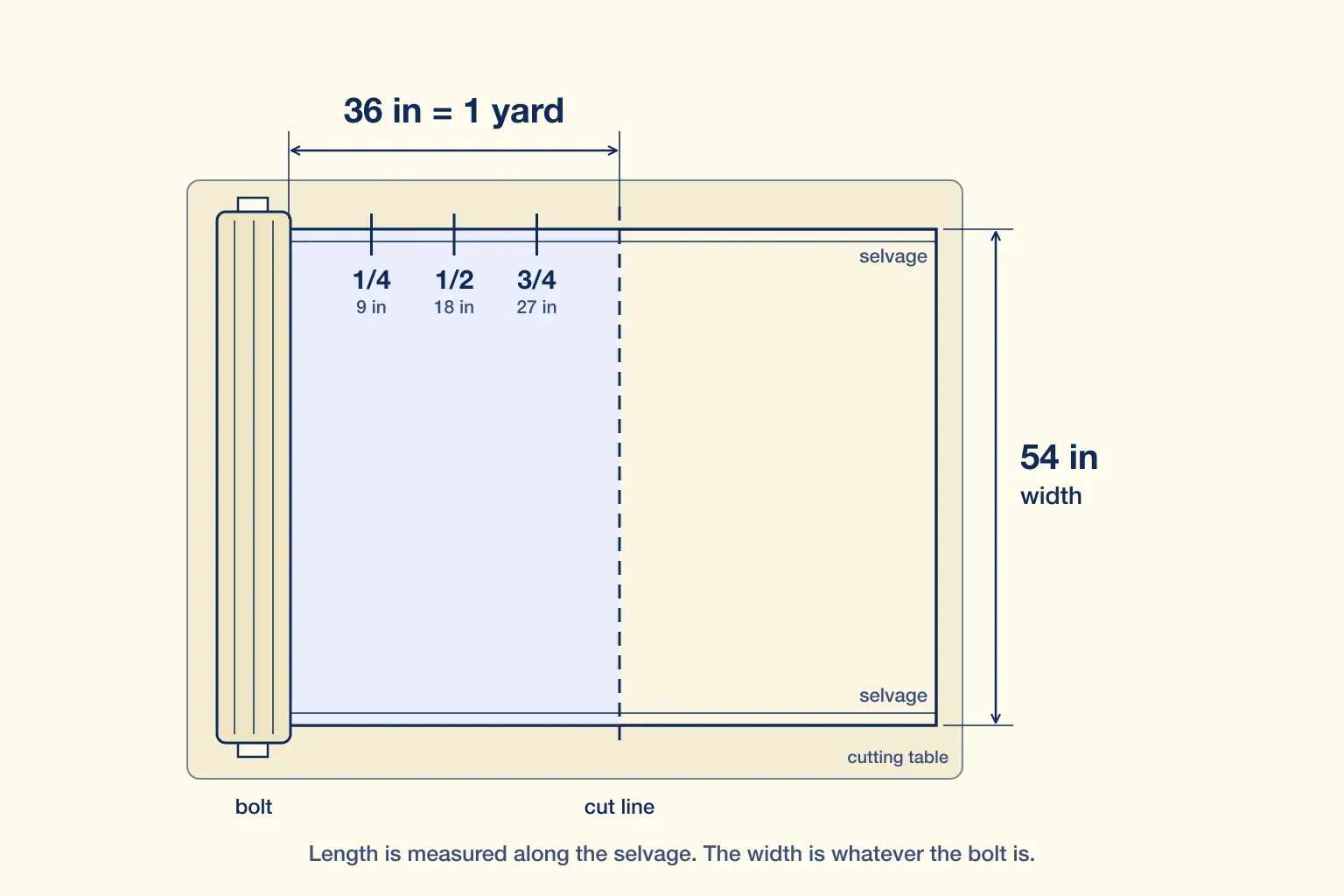
A yard of fabric is 36 inches measured down the length of the bolt. The width is whatever the bolt happens to be, so a yard of sheer and a yard of quilting cotton are the same length and very different amounts of cloth. Three yards of 54 inch decorator fabric is a piece 108 inches long and 54 inches wide, and three yards of 118 inch sheer is the same 108 inches long, just more than twice as wide.
The number itself is fixed. Since the 1959 international yard and pound agreement, the yard has been exactly 0.9144 metres, and NIST's conversion tables use that figure, so 1 yard is 91.44 cm and 1 inch is 2.54 cm.
How is fabric measured by the yard?
Fabric is measured along its length, parallel to the selvage, and cut straight across the width. A shop unrolls the bolt on a cutting table, counts off 36 inches for each yard, and cuts from selvage to selvage. You pay for length. The width comes free with it, whether that's 44 inches or 118.
The selvage is the tightly woven edge that stops the cloth fraying, and it runs the long way down the bolt. Big Z Fabric's buying tutorial makes the same point from the store side: the length they sell runs along the fabric, and the white selvage edges aren't counted in the usable width.
Common bolt widths are worth knowing before you shop:
- Quilting and dressmaking cotton: 42 to 44 inches, often labeled 44/45.
- Decorator and curtain fabric: 54 inches is the standard, some at 72.
- Sheers and voiles: 118 inches, made wide so a whole curtain can be cut in one piece.
- UK and EU curtain fabric: sold by the metre, usually 137 or 140 cm wide.
Yard fractions in inches and centimetres
Most shops cut in eighths or quarters of a yard. This chart gives you each step in inches and cm, so you can match a pattern to the counter.
| Fraction of a yard | Inches | Centimetres |
|---|---|---|
| 1/8 yd | 4.5 in | 11.4 cm |
| 1/4 yd | 9 in | 22.9 cm |
| 1/3 yd | 12 in | 30.5 cm |
| 3/8 yd | 13.5 in | 34.3 cm |
| 1/2 yd | 18 in | 45.7 cm |
| 5/8 yd | 22.5 in | 57.2 cm |
| 2/3 yd | 24 in | 61.0 cm |
| 3/4 yd | 27 in | 68.6 cm |
| 7/8 yd | 31.5 in | 80.0 cm |
| 1 yd | 36 in | 91.4 cm |
If you also quilt, note that a fat quarter isn't a quarter yard. She Makes Joy's precut guide puts a fat quarter at about 18 by 22 inches, against 9 inches by the full width for a quarter yard.
How to measure fabric you already have
Lay it flat on the floor or a long table, right side up, and smooth it out without pulling. Stretching it even a little adds inches you don't have, and knits and loose weaves stretch easily.
Measure down one selvage, not across the middle. A standard 60 inch sewing tape won't reach on a long piece, so put a pin at every 36 inches and count the pins. Then measure the short bit left at the end.
To turn inches into yards, divide by 36. A 130 inch remnant is 130 / 36 = 3.61 yards, or 3 yards and 22 inches. Measure the width too, selvage to selvage, because a remnant sold as "54 inch" can be 52 once the edges are trimmed, and that 2 inches matters when you're counting widths for a curtain.
How do you convert curtain inches to yards?
Add up the cut length of every width you need, divide by 36, and round up to the next step your shop cuts, usually a quarter yard. Never round down. If the total comes to 404 inches, that's 11.22 yards, and 11 yards (396 inches) leaves the last drop 8 inches short.
Here's that 404 worked through, since it's a typical pair. Say the rod is 72 inches, you want pencil pleat at 2x fullness, and the fabric is 54 inch decorator goods with a 2 inch side hem on each edge.
- Flat width needed: 72 x 2 = 144 inches.
- Usable width per drop: 54 minus 4 = 50 inches.
- Widths: 144 / 50 = 2.88, so 3, and a pair needs an even split, so 4 (2 per curtain).
- Cut length per width: 84 inch finished drop, plus 5 inches for the heading, plus 12 inches for a 6 inch double hem = 101 inches.
- Total: 4 x 101 = 404 inches, which is 11.22 yards.
At quarter-yard steps you'd buy 11 1/4 yards, which is 405 inches. That's 1 inch of slack across four cuts, which is no slack at all.
The curtain fabric calculator runs this whole chain for you. Put in the rod width, the drop, the heading, and the fabric width and it gives the widths to cut, the cut length, and the total in yards and inches (it shows the example above as 11 yd 8 in), or in metres if you switch units. If your fabric has a pattern, the cut length grows to a whole repeat first, which pattern repeat explained walks through.
How much extra fabric should you buy?
Buy an eighth of a yard extra for squaring up, and more if the fabric will shrink. Seamwork's grain guide suggests the extra 1/8 yard (4.5 inches) because fabric often comes off the bolt a little crooked. For washable linen or cotton you'll prewash, add the shrinkage on top.
Straightening matters more on curtains than on most projects. Each drop is long, and a cut that starts 1 inch off square at the top hangs visibly skewed at the hem. The fix is to snip into the selvage, pull one crosswise thread until it gathers, and cut along the line it leaves. That line is straight grain. The fabric you trim off to reach it is what the extra eighth pays for.
Shrinkage is the bigger number. Fabrics-store.com, which sells mostly unwashed linen, plans on 10% shrinkage for any fabric it doesn't list separately. On the 404 inch order that's another 40 inches, so you'd want about 444 inches plus the eighth, roughly 12 1/2 yards, if you're going to prewash. Dry-clean-only decorator fabric doesn't get washed, so skip this step for it.
Buy it in one continuous cut
Each drop of a curtain has to be one unbroken length, so buy the whole order as one piece, ideally off one bolt. Ask for a continuous cut. Many online shops send multiple yards as a single piece (order ten half yards and you get five yards in one length), but some don't, and it's worth checking the listing before you pay.
The one-bolt part is about colour. Two bolts of the same fabric can come from different dye lots, and side by side at a window a small shift in shade is obvious. If the shop can't fill your whole order from one bolt, ask before you buy rather than after you've cut.
Wide windows raise a related question: whether to turn the fabric sideways and run it along the width. Fabric width and railroading covers when that saves yardage and when it doesn't.
Buying by the metre instead
In the UK, Europe, and Australia, curtain fabric is sold by the metre. One metre is 39.37 inches, about 1.09 yards, so a metre is a little more fabric than a yard. The 404 inch order above is 10.26 metres. Round up and add the same allowances.
Don't convert a pattern that's written in yards into metres one to one. Ten yards is only 9.14 metres, so ordering "10" of the wrong unit leaves you nearly a full metre short on a large curtain job.
If you haven't measured the window yet, start with how to measure for curtains, then come back to the yards.
Turn your window into yards
Enter the rod width, drop, heading, and fabric width and get the widths to cut and the total in yards and inches.