Drapes vs Curtains: What's the Difference?
Drapes are lined panels of heavier fabric, hung to the floor and pleated at 2 to 2.5 times the rod width. Curtains are a single layer of lighter cloth that can stop at the sill, the apron, or the floor, and they're sold ready-made. In the UK, both are called curtains. The lining is what separates them, and it changes your fabric order more than anything else.
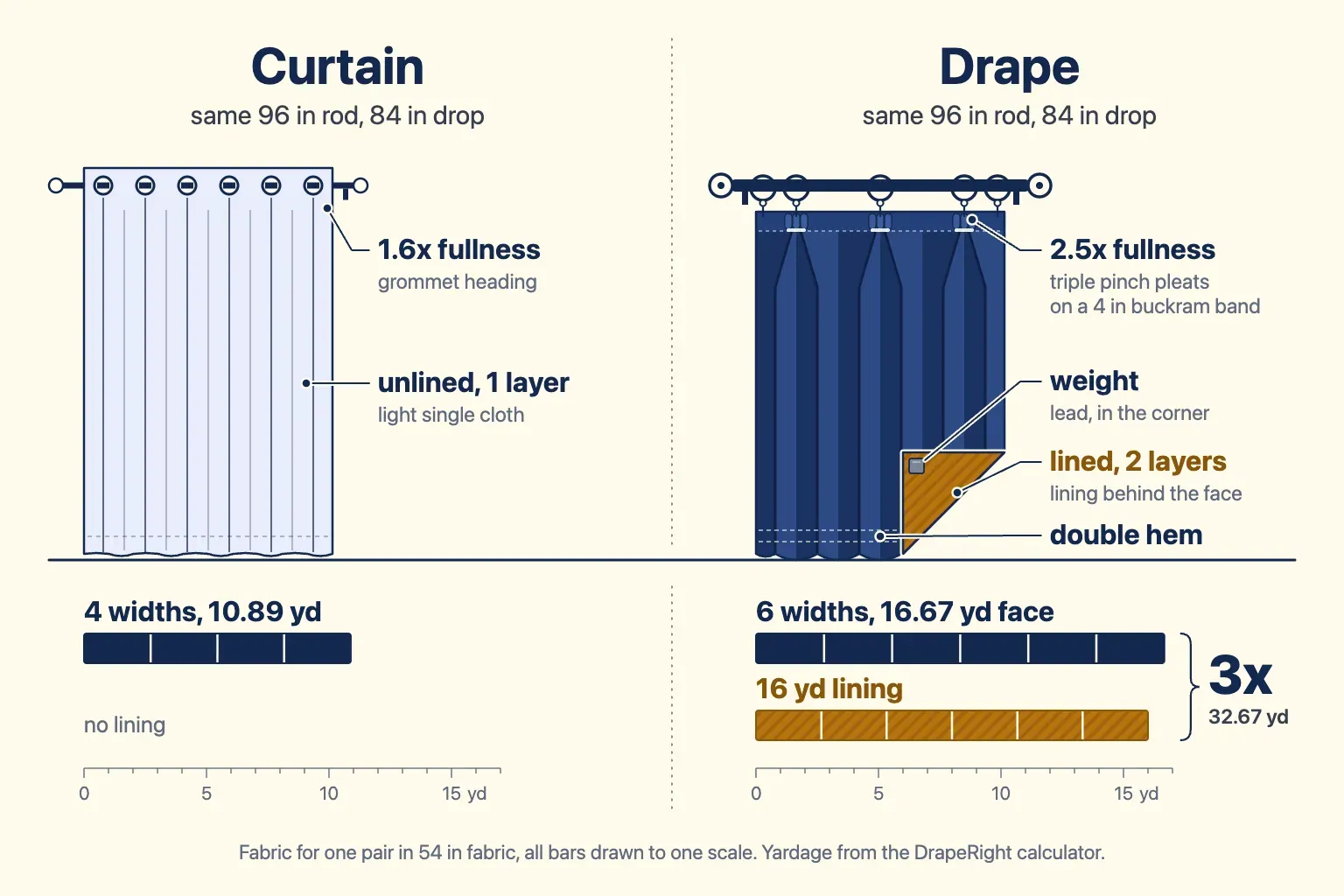
The Shade Store, which sells both under one name, traces the split to fabric. Drapes meant thick, long, lined panels. Curtains meant thinner, unlined cloth, sheers, and short cafe panels. That shows up fast on an order. On a 96 inch rod with an 84 inch drop, a pair of unlined grommet curtains takes 10.89 yards of 54 inch fabric in our calculator. Lined pinch pleat drapes on the same rod take 16.67 yards of face fabric plus 16 yards of lining. That's three times the cloth.
What is the difference between drapes and curtains?
Lining and weight. A drape is two layers, face fabric plus lining, in a heavier cloth, and it runs to the floor with pleats that take 2 to 2.5 times the rod width in fabric. A curtain is one layer of lighter fabric at 1.5 to 1.75 times, and it can end at the sill, the apron, or the floor.
Hunter Douglas lists the knock-on effects in its buyer's guide. Drapes need a sturdier rod because they're heavier. Curtains can go up on a tension rod, and drapes can't. Drapes often need professional cleaning, while most curtains take a gentle machine wash in cool water. Graber adds the buying side: curtains come pre-cut in set sizes, and drapery is made to the window.
| Feature | Curtains | Drapes |
|---|---|---|
| Fabric | Cotton, linen, polyester, sheers | Velvet, wool, silk, or a linen with lining |
| Lining | None on most | Almost always, and blackout or thermal is common |
| Length | Sill, apron (3 to 4 in below the sill), or floor | Floor, a light break, or a puddle |
| Fullness | 1.5x to 1.75x (tab top, grommet, rod pocket) | 2x to 2.5x (pencil, pinch, ripplefold) |
| Hems | Single bottom hem and header | Double hem, double header, weights at seams and corners |
| Hardware | Tension rod, cafe rod, or pole | Sturdy pole with rings, traverse rod, or track |
| Bought as | Ready-made, 63 to 144 in long | Made to measure |
| Cleaning | Gentle machine wash, cool water | Often professional cleaning |
The fullness numbers are the ones in the curtain fabric calculator: tab top 1.5, grommet 1.6, rod pocket 1.75, pencil and double pinch 2.0, triple pinch 2.5. Stoneside supplies the construction row and the 63 to 144 inch ready-made range. The Shade Store and Hunter Douglas cover fabric, length, hardware, and cleaning.
Headings cross over, though. The Shade Store sells grommet drapery, and nothing stops you sewing a pinch pleat in unlined voile. So the heading doesn't decide it. The lining and the weight of the cloth do.
Are drapes and curtains the same thing?
In everyday speech, close enough. The Shade Store says people swap the two words all the time and aren't wrong to, and it sells both under the one name, drapery. Cambridge Dictionary marks drapes (and draperies) as American English for heavy curtains made with thick cloth. In Britain, most people call both curtains.
The word comes from cloth. Drape goes back to the Old French drap, a piece of cloth, which is also where draper, the old name for a cloth seller, comes from.
Where the words matter is on a quote or a label. Ask a workroom for drapery and it will price lining, pleats, and your exact width and drop. Walk down a store aisle and you'll find foam-backed blackout panels sold as curtains. So read the label for lining and fabric weight, and ignore the name on the package.
How much more fabric do drapes take?
Two to four times the cloth, once you count the lining. Drapes need more width for their fullness and a second layer behind the face fabric. On some windows both round to the same number of fabric widths, so the lining alone doubles the order. On a wide window, the pleats add whole widths as well.
Here's one pair of each, run through the calculator with an 84 inch finished drop, 54 inch plain fabric, 2 inch side hems, and the same 4 inch double bottom hem on both, so only the heading and the lining change.
| Rod width | Grommet curtains, unlined | Triple pinch pleat drapes, lined |
|---|---|---|
| 48 in | 2 widths, 5.44 yd | 4 widths, 11.11 yd + 10.67 yd lining |
| 72 in | 4 widths, 10.89 yd | 4 widths, 11.11 yd + 10.67 yd lining |
| 96 in | 4 widths, 10.89 yd | 6 widths, 16.67 yd + 16 yd lining |
| 120 in | 4 widths, 10.89 yd | 6 widths, 16.67 yd + 16 yd lining |
Look at the 72 inch row. Grommets need 72 x 1.6 = 115 inches of flat fabric, which is 2.3 widths once the side hems come off, and a pair rounds that up to 4. A triple pinch pleat needs 180 inches, 3.6 widths, and also lands on 4. The face fabric differs by only 8 inches, because the pleated header takes 2 inches more per cut (8 in against 6 in). Everything else is lining, and the order doubles.
At 96 inches the gap opens. The pleats need 4.8 widths, so a pair takes 6, while the grommets need 3.07 and still fit in 4. Add the lining and the drapes come to 32.67 yards against 10.89.
The 48 inch row is the worst case, four times the cloth, and most of that is rounding. The drapes need 2.4 widths, a pair can't split 3 widths evenly, and the calculator rounds each side up to 2. If you're sewing, you can cut the third width in half and make 1 1/2 widths a side. That's 3 cuts instead of 4: 8.33 yards of face fabric and 8 of lining, against 11.11 and 10.67.
What turns a curtain into a drape when you sew it
Three things, and none of them is the heading. First, the lining. It's cut to the same number of widths as the face fabric but a little shorter, since it stops above the hem: the calculator cuts it at 96 inches against 100 for the face on an 84 inch drop. Our guide to curtain lining types compares blackout, thermal, and interlining.
Second, the hems. Stoneside describes a drape with a double hem at the bottom and a double header at the top, where a ready-made curtain has a single turn at each end. In the table above, that's a 4 inch hem turned twice, 8 inches of fabric on every cut.
Third, weights. Stoneside's drapes have lead weights sewn in at the seams and corners, which keep the bottom edge in line and stop the corners kicking out. Ready-made curtains rarely have them.
Pleats are the usual finish, but you have a choice. A pinch pleat vs ripplefold comparison shows how the two most common drapery headings differ in stack, fullness, and hardware.
Do drapes keep a room warmer than curtains?
A little, and the way you hang them matters more than the cloth. Cornell Cooperative Extension's fact sheet on energy-saving window treatments rates conventionally hung draperies at 5 to 10% less heat loss through the window. Tightly woven drapes with a separate lining, sealed at all four edges, reach about 25%.
Sealed means three things in that fact sheet. Close off the top with a cornice so warm air can't drop down behind the fabric. Let the hem touch the sill or the floor. And overlap the two panels by 4 inches where they meet. The sheet also puts windows at 25 to 35% of a house's heat loss, so the drape is working on a big share.
An unlined curtain that stops at the sill can't seal at the bottom or hold a layer of still air behind it. For a cold room, the heat case goes to lined drapes that reach the floor. Our curtain length guide covers float, break, and puddle if you're deciding how far past the floor to go.
Which should you pick for each room?
Pick by what the room does all day.
- In a kitchen or bathroom, hang curtains. The Shade Store points to cafe or sill-length panels near sinks and counters, where long fabric gets splashed.
- A bedroom, nursery, or TV room wants drapes with a blackout lining. The lining stops the light, and the floor length closes the gap at the bottom.
- In a living room with large windows, use drapes, or sheer curtains layered behind them, so you can filter daylight by day and close up at night.
- In a rental, or at a window you can't drill around, curtains on a tension rod go up without a single hole.
- A cold room or old single glazing needs lined drapes to the floor, sealed the way Cornell describes.
Plan the hardware with the choice. Lined drapes weigh a lot more than unlined curtains, so use a solid pole with a center bracket once the rod passes about 60 inches, or a traverse rod or track. The Shade Store also notes that puddled drapery suits panels you leave in place. If you open and close them every day, stop them at the floor.
Working out your fabric
In the fabric calculator, drapes vs curtains comes down to two settings: the heading and the lining box. Enter your rod width and finished drop and pick grommet or rod pocket for a curtain. Note the yards, then switch to pinch pleat, tick lining, and run it again for the drape. Each run gives you the widths, cut lengths, and a cut list, so you can price the window both ways before you buy a yard.
Price your window both ways
Enter your rod width and drop, run it once as a curtain and once as a lined drape, and compare the yards before you buy.